
Travel Town & “Railroad Row”
Free outdoor museum in Griffith Park preserving 43 historic locomotives, passenger cars, and freight trains from California's railroad era.
- See
Travel Town & “Railroad Row” Details
- Tuesday-Sunday: 10am-5pm
- Closed: Mondays & Christmas Day
Overview
Details
Experiencing Travel Town & “Railroad Row” / Curious LA Field Notes
Quick Take
Travel Town preserves California's railroad history through 43 full-size locomotives and cars you can actually walk around and sometimes climb into. The free outdoor setting makes these massive machines accessible in a way indoor museums can't match. Kids get to peer into engineer cabs while adults appreciate the craftsmanship of equipment that connected the West. The miniature train ride adds hands-on fun, and standing next to a 200-ton steam engine shows the scale of what moved America.
Two volunteer-run attractions share the property: the Los Angeles Live Steamers operates rideable miniature trains every Sunday, and Walt's Barn opens monthly to showcase Walt Disney's personal railroad workshop from his Holmby Hills home. Together, these three sites create a railroad destination where you can see historic equipment, ride miniature trains, and explore Disney's railroad legacy.
What You’ll See
The museum spreads across open grounds where locomotives and cars stand ready for close inspection. Walk right up to Southern Pacific #3025, a 1904 passenger engine with towering drive wheels that once pulled coastal trains. Union Pacific switcher #4439 worked the Los Angeles Harbor until air quality regulations retired it in 1957. Santa Fe #664, built in 1899, hauled freight across five divisions for 54 years before joining the collection.
Massive steam engines dominate the main display area under a large hangar. Smaller industrial locomotives show different aspects of railroad work. Three-truck Heisler and Shay engines represent logging operations. Tank engines recall harbor construction projects. Each machine carries plaques explaining its working history.
Passenger cars let you step inside and see how people traveled by rail. The Pullman sleeping car “Rose Bowl” survived a 1939 accident and went on to serve the famous City of Los Angeles streamliner. A Pennsylvania Railroad dining car from 1925 shows where passengers ate meals on long journeys. Some cars have original upholstery and fixtures intact.
The Indoor Gallery
Head inside the main building for smaller artifacts and displays. Railroad china patterns, dining car menus, and timetables fill cases. Signal equipment shows how crews communicated. Track samples demonstrate the evolution from wooden ties to concrete. A cut-away boiler lets you see inside a steam engine’s heart.
Narrow-gauge cars from the Owens Valley occupy one section. These smaller wooden cars carried mail, freight, and livestock across remote California regions. A railway post office car shows how mail moved before highways.
The Miniature Train
A 16-inch gauge railway circles the museum grounds. The covered passenger cars make two loops around the collection, passing locomotives and equipment from an elevated vantage point. Rides cost $4 for adults, $3 for kids and seniors. The train operates most days when the museum is open, with a lunch break on weekdays.
Kids love this ride, but it works equally well for adults who want a different perspective on the collection. The 10-minute journey gives views you can’t get walking the grounds.
Making the Most of Your Visit
Start at the main hangar where the largest locomotives cluster. Walk the full length to grasp the size differences between passenger engines and industrial switchers. Look for open cabs where you can peek inside at the controls.
Move to the passenger cars next. Some you can enter, others just view from outside. Check the plaques for each car’s history and which railroad operated it.
Save the indoor gallery for last, when you need a break from sun or want to see smaller details. The exhibits explain how railroads worked beyond just the trains themselves.
The museum takes one to two hours for a casual visit. Serious railroad enthusiasts can easily spend three hours examining details. Families with young children often stay longer, combining the miniature train ride with picnic time in the adjacent areas.
Photography works well here. The outdoor setting provides natural light, and you can shoot from multiple angles around most equipment. Early morning or late afternoon light enhances the weathered steel and paint.
The Story Behind It
Charley Atkins, a Recreation and Parks employee, started this collection in the late 1940s when steam locomotives faced scrapping as diesels took over. He contacted California railroads asking for donations. Companies responded generously since the transition meant surplus equipment.
Travel Town opened December 14, 1952. Early locomotives were accessible day and night until vandalism forced fencing in 1955. The collection grew through the 1960s as more railroads donated retired equipment. Each piece connects to California’s development through commerce, agriculture, or passenger service.
The museum represents a rescue effort. Without these donations, most of these machines would have been scrapped for metal. Now they show how railroads transformed California from isolated settlements into connected communities.
What to Know
The outdoor location means weather matters. Summer heat can make walking among metal locomotives uncomfortable. Spring and fall offer better conditions. Winter works fine with appropriate clothing.
Wear comfortable shoes for walking on gravel and pavement. Some areas have uneven surfaces. Strollers and wheelchairs can navigate most pathways, though entering train cars requires climbing steps.
The collection shows age and weather exposure. Some equipment needs restoration. This adds authenticity but means not everything appears pristine. Peeling paint and rust tell their own story about preservation challenges.
Bathrooms, water fountains, and the gift shop provide basic amenities. Vending machines sell drinks and snacks. Picnic areas nearby in Griffith Park accommodate groups who want to make a longer outing.
Keep the Train & Railroad Party Going…
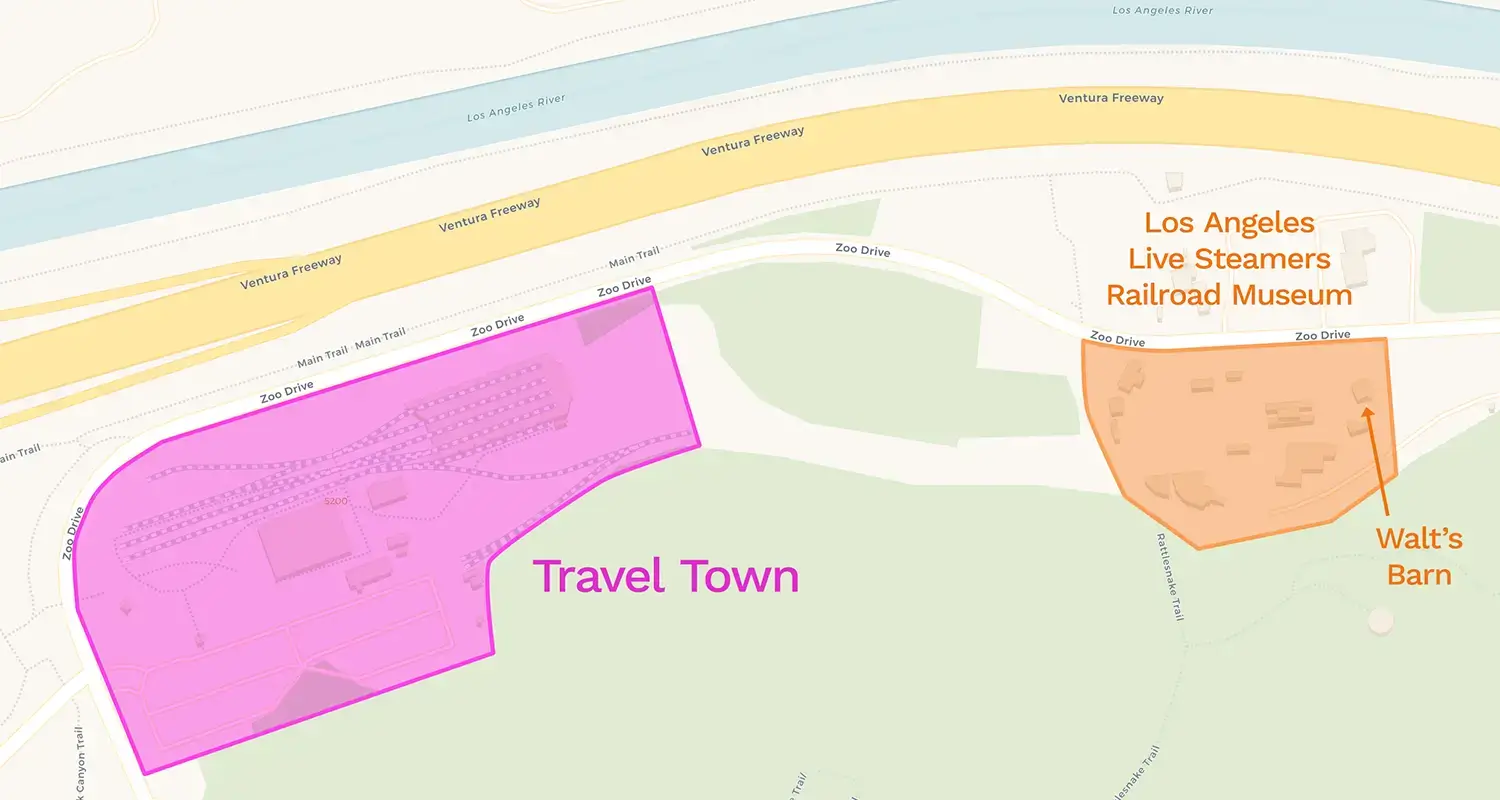
Just down the road from Travel Town are the Los Angeles Live Steamers Railroad Museum and Walt’s Barn – two smaller train-based attractions worth adding to your visit.
Not being able to find an existing nickname for this collection of “Train & Rail”-focused destinations, we’re calling all three of these spots “Railroad Row.”

Los Angeles Live Steamers Railroad Museum operates right next door at the same address (5202 Zoo Drive). This volunteer-run museum features rideable 7.5-inch gauge miniature trains that circle a 1.5-mile track through landscaped grounds. You ride these trains by straddling them like a horse, not sitting in passenger cars. The 12-minute journey passes miniature bridges, an old west town, and an abandoned mine.
All the locomotives and track were built by club members who are passionate about live steam, gas-mechanical, and electric railroad technology. The museum buildings occupy restored full-size train cars including a 1929 Santa Fe steel caboose and a 1956 Union Pacific sleeper car.
Open Sundays 11:00 AM to 3:00 PM (except the Sunday before Memorial Day and first Sunday in October). Suggested donation $3-4 per person. Check their website at lalsrm.org for weather closures since operations depend on conditions.
Walt’s Barn sits within the Live Steamers property and opens one Sunday per month. This is the actual workshop barn from Walt Disney’s Holmby Hills home where he built and maintained his backyard Carolwood Pacific Railroad in the 1950s. When the property sold, Disney’s daughter Diane Miller saved the barn and had it relocated to Griffith Park in 1999.
Inside you’ll find Walt’s original workbenches (which he built by hand), his tools, model trains donated by Disney animators, photographs, and memorabilia documenting his lifelong passion for railroading. Outside stands the Retlaw 1 combine car from the original Disneyland Railroad and a restored train station from animator Ollie Johnston’s backyard.
The barn is small and gets crowded quickly. Lines can stretch to an hour on busy days. The displays are mainly look-but-don’t-touch, though some model trains offer hands-on interaction.
Open the third Sunday of each month, 11:00 AM to 3:00 PM. Free admission, donations accepted. Check their Instagram @WaltsBarn or website carolwood.org/walts-barn for schedule changes.
Both attractions coordinate their schedules, so visiting on the third Sunday of the month lets you experience all three railroad sites in one trip.
What Others are Saying
Nearby Curious Los Angeles Destinations
Bee Rock
Beehive-shaped sandstone summit with sweeping city views and a path through the abandoned 1912 Los Angeles Zoo ruins.
Views of the Hollywood Sign: Last House on Mulholland
Vacant lot at the end of Mulholland Highway offering the closest public approach to the Hollywood Sign for selfie-seekers.
Old Los Angeles Zoo
Explore the abandoned 1930s-era zoo ruins and grottos turned picnic area in the heart of Griffith Park for a unique…
Dante’s View
Historic folk garden on Mount Hollywood's slopes with sweeping city views and terraced paths built by a volunteer in 1964.
Wisdom Tree
Steep trail to a solitary pine that survived a 2007 wildfire, offering sweeping city views and a tradition of leaving…
Griffith Park Merry-Go-Round
Historic 1926 carousel where Walt Disney conceived Disneyland, featuring hand-carved horses and one of the West Coast's largest band organs.
Views of the Hollywood Sign: Lake Hollywood Park
Grassy park with unobstructed front views of the Hollywood Sign, popular for family picnics and effortless photo opportunities.
Horror Row
Two walkable blocks where Halloween never ends and the macabre meets mainstream shopping year-round
Bronson Caves
Historic Hollywood filming location where a former quarry tunnel became the iconic 1960s Batman Batcave entrance.
Griffith Observatory
Iconic Art Deco observatory offering free astronomy exhibits, planetarium shows, public telescopes, and sweeping views of LA and the Hollywood…
Travel Town & “Railroad Row” on Other Sites