
Space Shuttle Endeavour
NASA's youngest space shuttle, displayed vertically in the only complete launch stack in the world
- See
Space Shuttle Endeavour Details
Overview
Details
Experiencing Space Shuttle Endeavour / Curious LA Field Notes
Quick Take
Endeavour represents the shuttle program's ability to recover from tragedy and achieve the impossible. Built from spare parts in just three years after the Challenger disaster, this orbiter completed missions other shuttles couldn't—hand-grabbing a wayward satellite on its first flight, giving Hubble its "vision" back, and pioneering longer-duration flights. When the new Air and Space Center opens, the vertical launch display will let visitors experience the shuttle from angles astronauts never saw: looking down from 200 feet above the nose, walking around the base of the massive rocket boosters, and understanding the engineering of what it took to leave Earth's atmosphere.
What You’ll See When It Reopens
The Samuel Oschin Air and Space Center will display Endeavour as no shuttle has ever been shown. The orbiter stands mated to its external tank and solid rocket boosters in full launch configuration, just as it appeared on the pad at Kennedy Space Center before each of its 25 flights to space. The 200-foot stack rises through six levels of the building, with observation points at multiple heights.
A gantry elevator takes visitors nearly to the top for a view down onto the shuttle’s nose—a perspective NASA technicians had but astronauts never experienced. Glass platforms let you look directly at the crew compartment windows and the black heat-resistant tiles that protected the shuttle during reentry. The scale becomes clear from up here: each wing stretches 39 feet from the fuselage, and the entire orbiter weighs 178,000 pounds empty.
Lower observation levels bring you face-to-face with the cargo bay doors, the three main engines (each capable of generating 418,000 pounds of thrust), and the intricate thermal protection system. A 45-foot slide provides a quick route from the second level back down to the ground floor, where you can walk around the base of the solid rocket boosters.
Endeavour’s Remarkable History
NASA authorized this shuttle’s construction in 1987, after Challenger’s loss left the fleet one orbiter short. Rather than refit the prototype Enterprise, engineers built Endeavour from structural spares originally made during Discovery and Atlantis’s construction. The new shuttle incorporated improvements: a drag chute to reduce landing distances, upgraded computers with twice the memory, and connections for extended-duration missions.
The orbiter rolled out of the Rockwell facility in Palmdale in April 1991. Endeavour’s first mission in May 1992 didn’t go according to plan—but that made it memorable. When astronauts couldn’t capture the Intelsat VI satellite with the shuttle’s robotic arm, three crew members performed an unprecedented spacewalk to grab the five-ton satellite by hand. They succeeded, completing repairs and releasing it back to orbit.
Six months later, Endeavour carried Mae Jemison, the first African American woman in space. In December 1993, the shuttle launched on STS-61, the mission that saved the Hubble Space Telescope. Five spacewalks over five days installed corrective optics and new instruments to fix Hubble’s flawed vision. When the telescope transmitted its first images after the repair, they were razor-sharp—the mission worked.
Endeavour flew multiple missions to build and maintain the International Space Station, delivering the first U.S.-built module (Unity) in December 1998. The shuttle’s final flight in May 2011 delivered the Alpha Magnetic Spectrometer, a particle physics experiment still operating on the station today.
The Journey to Los Angeles
After NASA retired the shuttle fleet, more than twenty organizations competed to display Endeavour. The California Science Center won the orbiter in April 2011. On September 21, 2012, Endeavour arrived at Los Angeles International Airport atop a modified Boeing 747, making low passes over the California State Capitol, San Francisco’s Golden Gate Bridge, and Hollywood before landing at LAX.
Moving the shuttle from the airport to Exposition Park required careful planning. The 12-mile route took three days—October 12 through 14, 2012. Workers temporarily removed nearly 400 trees (replaced two-for-one afterward), raised power lines, and took down traffic signals to clear the way. The shuttle, mounted on a computer-controlled transporter, crept along at 2 mph. Its wings cleared apartment buildings by inches. Thousands lined the streets to watch, many gathering at landmarks like Randy’s Donuts for photos. The move cost roughly $10 million.
Why It Matters
Space shuttles were supposed to make spaceflight routine. They didn’t—the program proved more complex and expensive than NASA anticipated. But over 30 years and 135 missions, the five orbiters demonstrated what reusable spacecraft could accomplish: assembling a space station, repairing satellites, conducting thousands of experiments, and launching interplanetary probes.
Endeavour’s story shows what happens when engineers design for improvement. Every mission revealed better ways to fly, safer procedures, more capable systems. The youngest shuttle incorporated those lessons, and many of its innovations were retrofitted to the older orbiters.
The future exhibit preserves the complete shuttle system—orbiter, tank, and boosters—in launch position because that’s how these machines left Earth. Horizontal displays show the orbiter’s beautiful lines but miss the power of the full stack. Standing at the base of the boosters, looking up 200 feet to where the external tank meets the orbiter’s belly, visitors will understand what it took to reach orbit.
What Others are Saying
Nearby Curious Los Angeles Destinations

The Velaslavasay Panorama
Unique 360-degree painted panorama theater and garden preserving a lost 19th-century art form in a historic 1910 cinema.
Jack’s Candy
A 50,000-square-foot wholesale candy warehouse with over 10,000 varieties at bulk prices, no membership required.
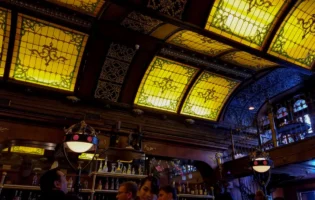
The Wolves
Belle Époque cocktail bar inside the historic Alexandria Hotel, featuring house-made ingredients and period-authentic 1900s design.
Octavia Lab & DIY Memory Lab
Free public makerspace with 3D printers, laser cutters, recording studios, and tools for creating everything from music to fashion.
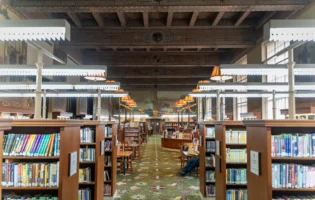
Los Angeles Central Library
Downtown's 1926 architectural landmark combining historic Art Deco design with modern library services across two connected buildings
The Last Bookstore
California's largest new and used bookstore housed in a 1914 bank building with book tunnels, literary labyrinths, and artist studios.
Bonaventure Hotel & BonaVista Lounge
Downtown's only revolving cocktail lounge inside five iconic cylindrical glass towers that redefined futuristic architecture in 1976.
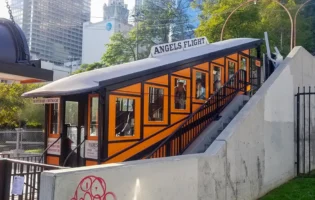
Angels Flight Railway
Historic 1901 funicular railway connecting downtown Los Angeles to Bunker Hill in a 298-foot journey up the city's steepest grade.
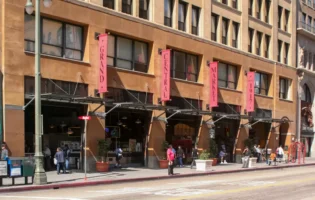
Grand Central Market
Downtown's oldest food hall serving up LA's multicultural flavors since 1917 in a historic Beaux-Arts landmark
Bradbury Building
A Victorian light-filled atrium hidden behind a plain brick facade, famous as the setting for Blade Runner's climactic scenes.
Space Shuttle Endeavour on Other Sites