Griffith Observatory
Iconic Art Deco observatory offering free astronomy exhibits, planetarium shows, public telescopes, and sweeping views of LA and the Hollywood Sign.
- Do
- See
Griffith Observatory Details
- Tuesday-Friday: 12:00pm-10:00pm
- Saturday-Sunday: 10:00am-10:00pm
- Closed Mondays
Overview
Details
Experiencing Griffith Observatory / Curious LA Field Notes
Quick Take
Griffith Observatory draws over 1.5 million visitors annually to experience what its founder intended nearly a century ago: astronomy for everyone, not just scientists. The Art Deco building has appeared in films from "Rebel Without a Cause" to "La La Land," and the hands-on science inside keeps people coming back. You can watch demonstrations of historic equipment, look through working telescopes at real celestial objects, and attend planetarium shows where live narrators guide you through the cosmos. Since admission to the building and grounds is free, you only pay if you want to see a planetarium show.
The Building and Location
Griffith Observatory sits 1,134 feet above sea level on Mount Hollywood’s southern slope. The Art Deco structure, completed in 1933 and opened to the public in 1935, features Greek and Beaux-Arts elements mixed with Moderne influences. The exterior showcases Greek key patterns and copper domes housing telescopes. Inside, Hugo Ballin’s original 1934 murals cover the rotunda ceiling, depicting how ancient cultures interpreted the night sky through mythology and early astronomy.
The location provides clear sightlines across the Los Angeles Basin. On most days, you can see from Downtown Los Angeles to the Pacific Ocean. The Hollywood Sign sits on nearby Mount Lee, making the observatory one of the best spots to photograph the famous landmark. The building opens onto terraces where visitors gather at sunset to watch the city lights emerge below.
Inside the Observatory
Walk through the main entrance and you’ll encounter the Foucault Pendulum immediately. This 240-pound bronze ball hangs from a 40-foot cable attached to the rotunda ceiling. The pendulum swings in one constant direction while the Earth rotates beneath it, taking 41 hours to complete what appears to be a full rotation. A ring magnet gives the ball a small tug on each swing to keep it moving.
The exhibits spread across three levels. The Wilder Hall of the Eye examines how humans observe the universe, from naked-eye astronomy to modern telescopes. The Ahmanson Hall of the Sky focuses on objects visible in our sky—the Sun, Moon, planets, and stars. The lower-level Gunther Depths of Space Hall explores distant galaxies, with meteorite samples you can touch and an asteroid impact simulator showing the effects of space rocks hitting Earth.
The Tesla Coil sits in its own alcove off the main hall. Built in 1910 by aviator Earle Ovington for medical X-ray equipment, this machine transforms 160 volts of household current into 500 million volts. Staff run demonstrations roughly once per hour, when purple lightning arcs fill the Faraday cage surrounding the device. The noise and light show lasts a few minutes before the coil needs to cool down.
Telescopes and Sky Viewing
Two working telescopes occupy the building’s copper domes. The east dome houses the 12-inch Zeiss refracting telescope, installed when the building opened in 1935. Over 9 million people have looked through this scope, making it the most-viewed telescope in the world. The west dome contains a triple-beam solar telescope called a coelostat, which projects live images of the Sun onto a white screen.
Free public telescope viewing runs every night the observatory is open. Staff set up portable telescopes on the lawn and open the roof telescope for visitors. You can observe visible planets, the Moon, star clusters, and other celestial objects. Staff members explain what you’re seeing and help adjust the equipment. On cloudy nights, the roof may close, but the Zeiss telescope room stays open as an exhibit space.
The Planetarium Experience
The Samuel Oschin Planetarium seats 290 people under a 76-foot aluminum dome. A Zeiss Universarium Mark IX star projector works with digital laser projection to create the night sky on the dome surface. Unlike recorded planetarium shows, every program here features live narration. A trained presenter guides each 40-minute show, adjusting the pace and answering questions from the audience.
Current shows rotate but typically include programs about the universe’s structure, the search for water and life beyond Earth, and journeys through the solar system. Tickets cost $7 for adults, $5 for students and seniors, and $3 for children ages 5-12. You can only buy tickets in person on the day of the show—no advance sales exist. The box office opens when the building opens, and tickets sell in blocks throughout the day. Shows for children under 5 are restricted to the first show each day only.
Details for Your Visit
The observatory opens Tuesday through Friday from noon to 10 p.m. and Saturday through Sunday from 10 a.m. to 10 p.m. It closes on Mondays. Arrive at least two hours before closing if you want to see exhibits and catch a planetarium show. Sunset brings the biggest crowds, especially on weekends and holidays.
Parking in the main lot costs $10 per hour with no time limit. Payment machines accept credit cards only. The lot fills quickly on summer evenings and weekends. An alternative is parking at the Greek Theatre lot (free when no show is scheduled) and taking the DASH Observatory bus for 50 cents. The bus runs every 15-20 minutes from 10 a.m. to 10 p.m. daily.
Food and drinks are not allowed inside the building, but a café operates on the lower level. Restrooms sit next to the parking lot. The entire building and grounds are wheelchair accessible.
What Others are Saying
Nearby Curious Los Angeles Destinations
Ennis House
Frank Lloyd Wright's monumental Mayan Revival residence constructed from 27,000 hand-cast granite blocks rising above Los Feliz
The Trails
Rustic walk-up cafe at the base of Griffith Park serving house-baked pastries, sandwiches, and coffee since 2005.
Dante’s View
Historic folk garden on Mount Hollywood's slopes with sweeping city views and terraced paths built by a volunteer in 1964.
Bronson Caves
Historic Hollywood filming location where a former quarry tunnel became the iconic 1960s Batman Batcave entrance.
Bee Rock
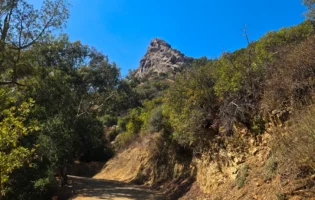
Beehive-shaped sandstone summit with sweeping city views and a path through the abandoned 1912 Los Angeles Zoo ruins.
Old Los Angeles Zoo
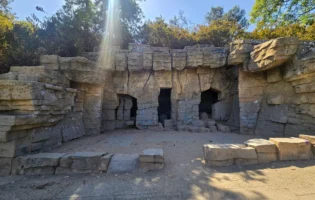
Explore the abandoned 1930s-era zoo ruins and grottos turned picnic area in the heart of Griffith Park for a unique…
Hollyhock House
Frank Lloyd Wright's first Los Angeles commission blends Mayan temple forms with California modernism atop a hilltop art park.
Philosophical Research Society
Nonprofit library and cultural center housing 30,000 rare books on philosophy, mysticism, and world religions in a 1930s Mayan Revival…
Griffith Park Merry-Go-Round
Historic 1926 carousel where Walt Disney conceived Disneyland, featuring hand-carved horses and one of the West Coast's largest band organs.
Soap Plant / Wacko
Pop culture emporium and lowbrow art gallery packed with 50+ years of curated oddities, handmade soaps, and underground treasures
Views of the Hollywood Sign: Last House on Mulholland
Vacant lot at the end of Mulholland Highway offering the closest public approach to the Hollywood Sign for selfie-seekers.
Griffith Observatory on Other Sites