
Ennis House
Frank Lloyd Wright's monumental Mayan Revival residence constructed from 27,000 hand-cast granite blocks rising above Los Feliz
- See
Ennis House Details
Overview
Details
Experiencing Ennis House / Curious LA Field Notes
Quick Take
This hilltop residence proved Frank Lloyd Wright could transform humble concrete blocks into monumental architecture. The house climbs a steep Los Feliz hillside in stages, each level built from thousands of hand-molded blocks cast with decomposed granite from the site itself. Wright wove steel reinforcing bars through the blocks like threads on a loom, creating walls that served as both structure and decoration. The result looks less like a conventional home and more like a temple rising from the California hills, which explains why Hollywood has used it to represent everything from futuristic dystopias to haunted mansions for nearly a century.
A House Built from the Hill
The Ennis House announces itself from blocks away. It rises in tiers up a steep hillside, a geometric fortress of patterned concrete that seems to grow directly from the earth. That impression isn’t accidental. Wright cast all 27,000 blocks from decomposed granite, gravel, and sand excavated from this exact spot. The material itself came from the hill.
Each block measures 16 inches square and three and a half inches thick. Workers cast them on-site using aluminum molds, then wove them together with steel reinforcing bars running through grooves along the edges. Wright called this his textile block system, comparing the construction to weaving fabric on a loom. The blocks form both the walls and the decoration, their relief patterns creating geometric shadows that shift throughout the day.
The design references Maya temples in the Yucatan, particularly structures at Uxmal. Wright studied these ancient buildings and borrowed their stepped profiles and intricate surface patterns. The blocks feature a Greek key design some interpret as a stylized letter “g,” possibly nodding to Charles Ennis’s membership in the Freemasons, who use a compass with a central “g” for God as their symbol.
Hollywood’s Favorite Fortress
Film crews discovered the house early. It debuted on screen in 1933’s Female, playing the mansion of an automotive executive. The 1959 horror film House on Haunted Hill established its reputation as a sinister location, though director Ridley Scott’s 1982 Blade Runner cemented the house in popular memory. That film used the exterior for Rick Deckard’s apartment building and recreated the textile block patterns for interior sets built at Warner Brothers.
The house has since appeared in more than 80 productions, from Twin Peaks and Buffy the Vampire Slayer to Rush Hour and Mulholland Drive. Directors favor it for scenes requiring exotic or ominous settings. The architectural historian Thom Andersen observed that “the Ennis house apparently transcends space and time,” serving as everything from gangster lairs to futuristic towers to vampire mansions.
Visiting Today
The house functions as a private residence with limited public access. A conservation easement requires the owner to open it for tours at least 12 days each year. Interior visits require advance appointments made through moc.esuohsinne@ofni. Spots fill quickly when tours are announced.
Even without going inside, you can view the exterior from Glendower Avenue, though respect the narrow residential street and avoid blocking driveways. The house occupies a prominent hilltop site with the main entrance facing north. Multiple terraces step down the hillside, offering the occupants panoramic views stretching from Griffith Park to downtown Los Angeles.
The structure has survived significant challenges. The 1994 Northridge earthquake caused substantial damage, and torrential rains in 2005 eroded blocks and retaining walls. Billionaire Ron Burkle purchased the property in 2011 and invested millions in restoration, replacing roughly 4,000 damaged blocks and sealing the structure against future weather damage. The Los Angeles Conservancy holds a conservation easement protecting the house permanently.
Architectural Context
Wright completed this house in 1924-1925, making it the last of his four Los Angeles textile block experiments. The others were La Miniatura in Pasadena (1923), the John Storer House in Hollywood Hills (1923), and the Samuel Freeman House in Hollywood Hills (1924). Wright’s son Lloyd supervised construction of all four houses.
The Ennis House differs from its siblings in scale and orientation. Where Wright typically favored horizontal designs emphasizing the prairie landscape, this house rises vertically, climbing the hill with an almost defensive posture. Wright himself later admitted he had pushed the textile block system beyond reasonable limits here. “That’s what you do, you know, after you get going, and get going so far, that you get out of bounds,” he said years later. “I think the Ennis house was out of bounds for a concrete block house.”
The house stands as proof that even Wright’s admitted excesses produced architecture people can’t stop looking at. Nearly a century after completion, it remains one of Los Angeles’s most photographed buildings.
What Others are Saying
Nearby Curious Los Angeles Destinations
Griffith Observatory
Iconic Art Deco observatory offering free astronomy exhibits, planetarium shows, public telescopes, and sweeping views of LA and the Hollywood…
The Trails
Rustic walk-up cafe at the base of Griffith Park serving house-baked pastries, sandwiches, and coffee since 2005.
Philosophical Research Society
Nonprofit library and cultural center housing 30,000 rare books on philosophy, mysticism, and world religions in a 1930s Mayan Revival…
Dante’s View
Historic folk garden on Mount Hollywood's slopes with sweeping city views and terraced paths built by a volunteer in 1964.
Soap Plant / Wacko
Pop culture emporium and lowbrow art gallery packed with 50+ years of curated oddities, handmade soaps, and underground treasures
Hollyhock House
Frank Lloyd Wright's first Los Angeles commission blends Mayan temple forms with California modernism atop a hilltop art park.
Old Los Angeles Zoo
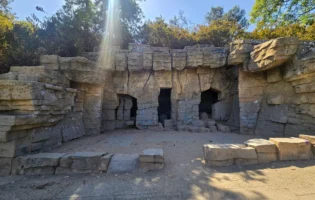
Explore the abandoned 1930s-era zoo ruins and grottos turned picnic area in the heart of Griffith Park for a unique…
Griffith Park Merry-Go-Round
Historic 1926 carousel where Walt Disney conceived Disneyland, featuring hand-carved horses and one of the West Coast's largest band organs.
Bee Rock
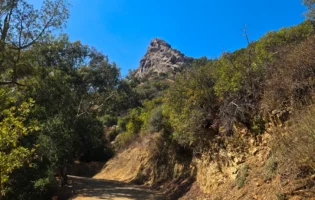
Beehive-shaped sandstone summit with sweeping city views and a path through the abandoned 1912 Los Angeles Zoo ruins.
Bronson Caves
Historic Hollywood filming location where a former quarry tunnel became the iconic 1960s Batman Batcave entrance.
Vista Theatre
Century-old single-screen palace with Egyptian Revival interiors showing films exclusively on 35mm and 70mm under Quentin Tarantino's ownership
Ennis House on Other Sites