
Corita Art Center
Downtown gallery preserving the colorful pop art serigraphs and social justice legacy of artist Corita Kent (1918-1986).
- See
Corita Art Center Details
- Saturdays 11am-4pm
- Fridays 11am-5pm (reserved for nonprofit and school groups)
Overview
Details
Experiencing Corita Art Center / Curious LA Field Notes
Quick Take
Corita Kent created nearly 800 serigraph editions between the 1940s and 1980s, transforming advertising slogans, song lyrics, and Bible verses into colorful prints that doubled as protest art. Her work sits at the intersection of pop art and activism, borrowing Andy Warhol's visual language to comment on civil rights, the Vietnam War, and economic inequality. The center makes her under-recognized contribution to American art accessible through intimate exhibitions where you can examine the typography, color choices, and layered messages that made her work both popular and controversial during the 1960s. She designed the 1985 LOVE postage stamp, cementing her place in American visual culture.
The Collection
Walk into the gallery and you see walls covered with bright serigraphs featuring overlapping text and images. Kent’s prints pull from Wonder Bread packages, street signs, and protest slogans, all rendered in the saturated yellows, magentas, and cyans that defined 1960s graphic design. The current Heroes and Sheroes exhibition shows 29 prints she created between 1968 and 1969, a series honoring figures like Martin Luther King Jr., Cesar Chavez, and Robert Kennedy. Her handwritten text layers over photographs and abstracted forms, creating visual essays that require close reading.
The gallery space feels intimate. Most pieces hang at eye level in a single room, allowing you to move between works and notice how Kent repeated certain compositional strategies. She often placed lowercase letters over images, creating what looks like accidental collisions between words and pictures. The effect draws you in to decipher meaning from the layered elements.
Kent’s Artistic Evolution
Kent joined the Immaculate Heart of Mary order at 18 and spent two decades teaching art before developing her signature style. Her early work featured figurative religious imagery, but a 1962 visit to an Andy Warhol exhibition at Ferus Gallery changed her approach. She began incorporating commercial imagery and text, using silkscreen printing to create editions that could reach wide audiences. The center’s archive includes preparatory materials showing how she built compositions through layers of cut paper and handwritten notes to printers.
By the mid-1960s, her work had become explicitly political. Prints addressing poverty, racism, and the Vietnam War put her at odds with the conservative Los Angeles Archdiocese. Cardinal James McIntyre called her work blasphemous and forced most sisters out of their teaching positions. Kent left the order in 1968 and moved to Boston, continuing to create serigraphs until her death from cancer in 1986.
The Visit
Reservations are required, keeping visitor numbers small. Tours run on Saturday afternoons, with staff available to discuss Kent’s techniques and context. The exhibitions change regularly, rotating works from the collection and presenting thematic groupings. Some visits coincide with workshops where participants create their own prints using Kent’s compositional strategies.
The gift shop sells reproductions, books about Kent’s life and work, and merchandise featuring her designs. Proceeds support the center’s educational programs and preservation work.
Practical Considerations
The center occupies a third-floor suite in a building that also houses Groundwork Coffee on the ground floor. The space is small, with most visits lasting 45 minutes to an hour. ADA accessibility is complete, with step-free access throughout. The intimate scale means you can examine prints closely and ask questions without navigating crowds.
The Arts District location puts the center near restaurants, breweries, and galleries. Street parking requires patience, with paid lots available on Traction Avenue within a few blocks. The Little Tokyo-Arts District Metro station sits half a mile away.
What Others are Saying
Nearby Curious Los Angeles Destinations
Hauser & Wirth
International contemporary art gallery in a restored 1896 flour mill complex with free admission, restaurant, bookstore, and award-winning garden.
Little Tokyo
Historic five-block cultural district celebrating Japanese American heritage through authentic dining, shopping, and annual festivals since 1885
The Geffen Contemporary at MOCA
Frank Gehry-designed warehouse gallery showcasing large-scale contemporary art installations in Little Tokyo's industrial-chic space.
Triforium
Towering 1970s sculpture adorned with 1,494 multicolored glass prisms intended to sync light and music but plagued by technical failures.
Bradbury Building
A Victorian light-filled atrium hidden behind a plain brick facade, famous as the setting for Blade Runner's climactic scenes.
Our Lady Queen of Angels Catholic Church
Los Angeles' oldest church, founded in 1814, featuring Spanish Colonial architecture, gilded altar, and continuous Catholic worship.
Jack’s Candy
A 50,000-square-foot wholesale candy warehouse with over 10,000 varieties at bulk prices, no membership required.
The Last Bookstore
California's largest new and used bookstore housed in a 1914 bank building with book tunnels, literary labyrinths, and artist studios.
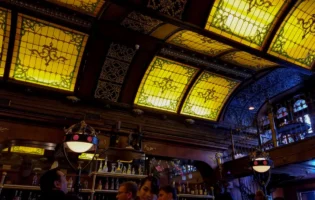
The Wolves
Belle Époque cocktail bar inside the historic Alexandria Hotel, featuring house-made ingredients and period-authentic 1900s design.
Olvera Street
Historic Mexican marketplace recreating old Los Angeles, with family-run shops, traditional food, and year-round cultural celebrations since 1930.
Corita Art Center on Other Sites