
Cathedral of Our Lady of the Angels
Downtown's postmodern architectural statement serves five million Catholics with alabaster light, saint tapestries, and a crypt beneath.
- See
Cathedral of Our Lady of the Angels Details
- Monday-Friday: 6:30am-6:30pm
- Saturday: 9:00am-6:00pm
- Sunday: 7:00am-6:00pm
Overview
Details
Experiencing Cathedral of Our Lady of the Angels / Curious LA Field Notes
Quick Take
The Cathedral of Our Lady of the Angels proves religious architecture doesn't require Gothic spires or stained glass to inspire awe. Moneo's design breaks nearly every traditional rule—no right angles, concrete instead of stone, alabaster replacing colored glass—yet creates a space that captures Southern California's light and multicultural spirit. The tapestries alone justify a visit: 135 saints depicted by ordinary LA residents, from kids in sneakers to faces reflecting the city's global population. This is where contemporary architecture meets sacred space on earthquake-proof foundations, offering visitors a free look at what Catholic design looks like in 21st-century Los Angeles.
Where Freeways Meet Sacred Space
Most European cathedrals sit beside rivers. This one hovers above the Hollywood Freeway, its concrete walls angled like a fortress built to catch California light. The Cathedral of Our Lady of the Angels occupies 65,000 square feet of downtown Los Angeles with all the subtlety of a concrete fortress—and that’s the point. Spanish architect José Rafael Moneo designed every angle, every surface, every shaft of light to reject centuries of European tradition and create something distinctly Californian.
The putty-colored walls recall the adobe missions that dot the state. Alabaster windows—more than 30,000 square feet of them—filter the famous LA sunlight into soft, warm tones that shift throughout the day. No stained glass saints gaze down from above. Instead, light itself becomes the decoration, pouring through slanted shafts and the cross-shaped “lantern” that crowns the sanctuary.
The Tapestries Tell the Story
Along both side walls, 25 tapestries stretch nearly from floor to ceiling. Artist John Nava created these works in his Ojai studio, then had them woven in Belgium using traditional techniques. The subjects—135 saints and blessed figures from Catholic history—appear in clothing appropriate to their eras and cultures. But here’s the twist: Nava used regular LA residents as models. Renaissance saints stand beside anonymous holy people. Children in athletic shoes appear among the faithful. The message reads clear: anyone can aspire to sainthood, even the person sitting next to you on the Metro.
At 3,000 square feet, this collection ranks as the largest group of tapestries hanging in any Catholic church in the United States. Step close and you’ll spot the texture Nava borrowed from Italian frescoes—stone-like surfaces in earth tones that feel ancient and modern at once.
What Lies Beneath
Take the elevator or stairs down one level and you’ll enter the crypt mausoleum. This isn’t a gloomy basement but a surprisingly bright space faced with polished Spanish limestone. Sixteen large stained glass windows from the original St. Vibiana’s Cathedral line the walls, lit from behind since they’re underground. These baroque revival pieces were created in Munich in the early 1920s and restored by Judson Studios before installation here.
Walk through and you’ll pass crypts housing Los Angeles’s Catholic history: the first bishop who brought Saint Vibiana’s relics from Rome in 1854, the first archbishop, the first Black bishop on the West Coast. In a simple alcove, two bronze plaques mark the resting place of Gregory Peck and his wife Veronique. His reads “Together,” hers says “Forever.”
Saint Vibiana herself—a third-century Roman martyr about whom little is known except that she died young—rests in a chapel created from the marble altar of her former cathedral. The relics were discovered in Roman catacombs in 1853 with only a vial of blood, a laurel wreath, and a tablet identifying her as “innocent and pure.”
Built to Last
The cathedral rests on 198 rubber pads that let the entire 151-million-pound structure float and move laterally during earthquakes. After the 1994 Northridge quake damaged the previous St. Vibiana’s Cathedral beyond repair, Moneo designed this replacement to survive for half a millennium. The concrete was formulated for 500-year durability. The Dobson pipe organ, one of the largest in the region, anchors the sanctuary alongside the archbishop’s chair and altar.
Outside, a large plaza recalls the church plazas common in Mexico, appropriate for a city founded as El Pueblo de Nuestra Señora la Reina de los Ángeles. A fountain near the Temple Street entrance quotes Jesus’s words to the Samaritan woman—”I shall give you living water”—in the dozens of languages spoken within the archdiocese.
What Others are Saying
Nearby Curious Los Angeles Destinations
Triforium
Towering 1970s sculpture adorned with 1,494 multicolored glass prisms intended to sync light and music but plagued by technical failures.
Our Lady Queen of Angels Catholic Church
Los Angeles' oldest church, founded in 1814, featuring Spanish Colonial architecture, gilded altar, and continuous Catholic worship.
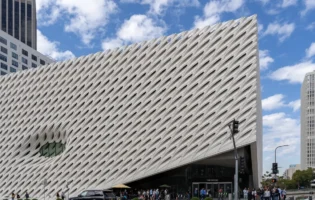
The Broad
Free contemporary art museum in downtown LA featuring postwar masterworks and Yayoi Kusama's Infinity Mirror Rooms.
The Museum of Contemporary Art, Los Angeles
Los Angeles's only museum dedicated exclusively to contemporary art, showcasing 8,000+ works from 1940 to today in a striking red…
Olvera Street
Historic Mexican marketplace recreating old Los Angeles, with family-run shops, traditional food, and year-round cultural celebrations since 1930.
Bradbury Building
A Victorian light-filled atrium hidden behind a plain brick facade, famous as the setting for Blade Runner's climactic scenes.
Philippe The Original
Historic downtown spot serving the original French dip sandwich since 1918 in a no-frills cafeteria with sawdust floors.
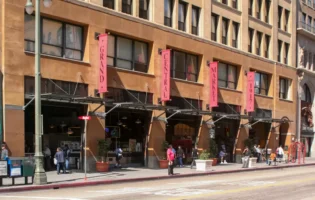
Grand Central Market
Downtown's oldest food hall serving up LA's multicultural flavors since 1917 in a historic Beaux-Arts landmark
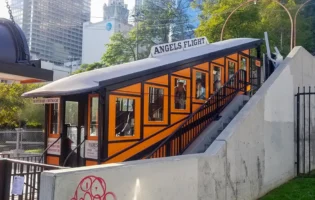
Angels Flight Railway
Historic 1901 funicular railway connecting downtown Los Angeles to Bunker Hill in a 298-foot journey up the city's steepest grade.
The Geffen Contemporary at MOCA
Frank Gehry-designed warehouse gallery showcasing large-scale contemporary art installations in Little Tokyo's industrial-chic space.
Little Tokyo
Historic five-block cultural district celebrating Japanese American heritage through authentic dining, shopping, and annual festivals since 1885
Cathedral of Our Lady of the Angels on Other Sites