
Camera Obscura
Historic 1898 optical device in a mid-century modern building, now home to rotating artist residencies and community workshops.
- Do
- See
Camera Obscura Details
- Monday-Friday: 9:00 AM - 3:00 PM
- Saturday: 11:00 AM - 4:00 PM
- Sunday: Closed
Overview
Details
Experiencing Camera Obscura / Curious LA Field Notes
Quick Take
The Camera Obscura tells two stories: Santa Monica's origins as a seaside playground in the 1890s, and its current commitment to accessible arts programming. Mayor Jones built his optical device to draw tourists to a young beach town, charging dimes to watch silent, live projections of the coast. Today, the building honors that legacy while serving a different purpose—giving working artists studio space and teaching the public everything from sewing to dance moves. The mechanism may be off-limits for now, but the space remains active, proving that historic buildings can adapt without losing their significance.
A Victorian Attraction Finds New Life
The Camera Obscura started as pure novelty. In 1898, when photography was still relatively new and motion pictures were just emerging, Mayor Robert F. Jones recognized that people would pay to see the world projected onto a table in a dark room. He charged 10 cents and set up shop on Santa Monica Beach, where the device became popular enough that Los Angeles briefly borrowed it for Westlake Park.
Jones wasn’t wrong about the appeal. Camera obscuras had been wowing audiences across Europe and America for decades. These oversized pinhole cameras worked through simple physics: light enters through a small opening, passes through a lens, bounces off an angled mirror, and projects an inverted image onto a viewing surface. The Santa Monica version added a rotating turret, allowing viewers to spin through a full 360-degree panorama of the coastline.
By 1910, the city bought the camera outright and moved it to what’s now Palisades Park. For nearly a century, visitors climbed stairs to a darkened room where silent, color images of Ocean Avenue traffic, beachgoers, and seagulls played out on a circular disk. Turn a ship’s wheel, and the view would shift—north toward the cliffs, south toward the pier, out to the Pacific horizon.
The Building Itself Becomes Art
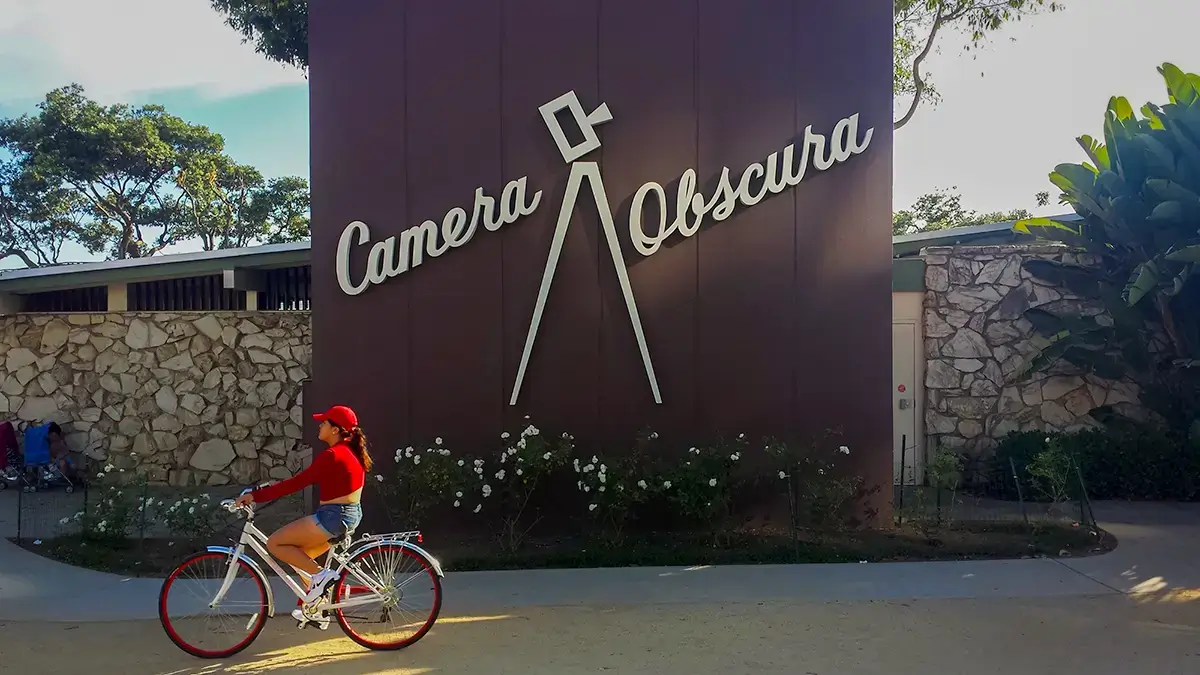
When the Senior Recreation Center was constructed in 1955, architect Weldon J. Fulton designed a specific room for the camera obscura mechanism. He also created one of Santa Monica’s most recognizable pieces of mid-century signage: large diagonal script spelling “Camera Obscura” paired with an abstract camera-on-tripod graphic. That same playful typography appears on his other local buildings, including Zucky’s deli and the Montana Branch Library.
Philanthropist Marcellus L. Joslyn donated the building to the city in memory of his wife. The structure shows off Fulton’s characteristic stonework and clean modernist lines, standing out along the park’s ocean bluff.
From Viewing Device to Creative Hub
In 2013, Santa Monica Cultural Affairs transformed the building into the Camera Obscura Art Lab. The historic mechanism remains installed but closed to public access as of July 2023. The space now focuses on contemporary art-making rather than historic viewing.
The Art Lab runs a residency program that brings in six Los Angeles County artists each year for 14-week terms. Artists work in glass-walled studios visible from the park, creating new pieces while the public watches. Each resident teaches workshops—anything from printmaking to movement classes—and presents their finished work at the term’s end.
Walk-in visitors can browse whatever exhibitions are currently on display or sign up for classes that change with each group of resident artists. The building also hosts dance workshops, writing sessions, and craft instruction. All programs aim at adults, filling a gap in a city where most creative spaces cater to children.
What Remains
The Camera Obscura mechanism itself waits in its darkened room, intact but inaccessible. City officials haven’t announced plans to reopen it. For now, the building’s historic function exists as context rather than experience—a reminder that this distinctive structure once served as entertainment, back when watching live projections felt as magical as any screen does today.
The Art Lab keeps regular hours, and admission costs nothing. Even without access to the 1898 device, the building offers something: working artists, community instruction, and that unforgettable Fulton signage catching afternoon light above Palisades Park.
What Others are Saying
Nearby Curious Los Angeles Destinations
Chez Jay
Santa Monica's nautical steakhouse where Hollywood history lives on through candlelit dinners, peanut shells, and 66 years of celebrity stories.
The Galley
Santa Monica's oldest restaurant and bar since 1934, serving classic steaks and seafood in a nautical-themed time capsule.
jAdis
Prop house and pre-digital curiosity museum where mad scientist laboratories come to life through antique scientific instruments and movie memorabilia
Annenberg Community Beach House
Historic Gold Coast estate with restored 1920s pool, splash pad, and beachfront amenities open to everyone, no membership needed.
Eames House
Mid-century modern landmark where Charles and Ray Eames lived, worked, and proved prefab could be beautiful.
Bergamot Station Arts Center
Former 1875 train depot converted into Santa Monica's largest concentration of contemporary art galleries with free admission.
McCabe’s Guitar Shop & Venue
Historic Santa Monica guitar shop and intimate 150-seat listening room hosting acoustic music legends since 1958.
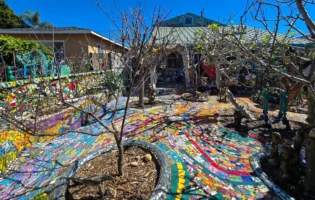
Mosaic Tile House
Working artists' home transformed into a living kaleidoscope of handmade tiles, broken ceramics, and found objects since 1994.
Venice Beach, Boardwalk, Skate Park & Muscle Beach
Two-mile stretch of LA's most famous beach, combining sand, surf, street performers, vendors, the legendary skatepark, and Muscle Beach gym.
Venice Canals
Tranquil residential waterways lined with eclectic homes, pedestrian bridges, and wildlife just blocks from Venice Beach's chaos.
Camera Obscura on Other Sites